
Eliminating “Stray Current”: Why Metro Rail Projects Are Shifting to FRP Third-Rail Covers
India’s metro rail network is expanding at a pace unmatched in the country’s infrastructure history. From Mumbai and Delhi to Bengaluru, Hyderabad, Pune, and Kochi, new metro corridors are being designed, tendered, and constructed with increasing technical sophistication. At the heart of these systems lies a critical but often invisible component: the third rail — the electrified conductor rail that delivers traction power to trains at 750V DC.
And wherever there is a third rail, there must be a FRP cover — or rather, there must be a FRP material cover. Here’s why metro rail projects globally and in India are standardising on FRP third-rail covers, and what this means for project safety, performance, and cost.
The Third-Rail Problem: Why Covers Are Non-Negotiable
A live third rail at 750V DC is lethal. Unlike overhead catenary systems where the live conductor is safely elevated above the track, a third rail runs at track level — within easy reach of maintenance personnel, trespassing pedestrians, and inadvertently dropped tools. Without a reliable protective FRP cover system, the third rail represents a constant electrocution risk.
Beyond direct electrocution, there’s a subtler but equally serious concern: stray current. In DC traction systems, a portion of the return current that should flow back through the running rails instead leaks into the surrounding soil and structure. This stray current causes electrochemical corrosion of buried metallic infrastructure — pipes, cable conduits, reinforcement bars — sometimes kilometres from the track.
Effective FRP covers play a role in stray current management by providing the proper electrical isolation that prevents unintended current paths at the third-rail interface.
What Is FRP Material? Why It’s Perfect for Third-Rail Applications
What is FRP material and why is it the preferred choice for this safety-critical component?
FRP — Fibre Reinforced Polymer — is a structural composite made from glass fibres bound in a polymer resin matrix. For third-rail cover applications, its properties are uniquely suited to the demands of the rail trackbed environment:
Electrical Non-Conductivity
The most fundamental requirement for a third-rail FRP cover is that it must not conduct electricity. FRP material has a dielectric strength that is orders of magnitude higher than any metal. It provides a reliable electrical barrier between the live conductor rail and anyone or anything that contacts the cover surface.
High Impact Resistance
Track environments are harsh. Ballast displacement, maintenance vehicle operations, and debris impacts demand a cover that won’t crack, shatter, or deform under load. FRP material offers excellent toughness and impact resistance — particularly in pultruded or compression-moulded cover designs with engineered profiles.
Corrosion Immunity
Track beds are wet, chemically active environments. FRP material is immune to all of these — no rust, no section loss, no degradation of protective properties over time. Running rail lubricants, biodegradation of organic matter, and seasonal temperature cycling create conditions where steel would corrode within years.
Lightweight for Fast Installation
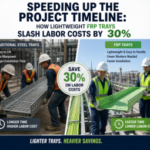
Third-rail FRP covers must be installed across the full length of every electrified section — sometimes tens of kilometres. Lightweight FRP material covers allow a small crew to handle, position, and fix large lengths of cover quickly, significantly reducing installation time and labour cost compared to any metallic alternative.
The Stray Current Connection: How FRP Covers Support System Integrity
Stray current is one of the most difficult challenges in DC traction system design. The magnitude of stray current leakage depends on the quality of the electrical isolation maintained throughout the traction power return circuit — including at the third-rail interface.
Metallic third-rail covers, if used, add unintended conductive paths at multiple points along the track. Even corroded or contaminated metallic covers create partial conductive bridges that contribute to stray current leakage. FRP material covers eliminate this entirely — they are electrically inert. This directly supports the rail system’s stray current mitigation strategy, protecting buried civil infrastructure and reducing long-term maintenance liability for the metro operator.
Specifying FRP Covers for Metro Projects: What to Look For
When specifying FRP covers for a metro third-rail application, the performance requirements are stringent. An experienced FRP products manufacturer should be able to provide:
- Dielectric strength certification: Typically tested per IS or IEC standards, confirming the cover material provides adequate electrical isolation at the rated traction voltage
- Impact test data: Drop test or pendulum impact certification confirming the cover will not shatter under accidental contact from maintenance tools or equipment
- Fire retardancy: Self-extinguishing resin system, certified per relevant rail fire safety standards (EN 45545 or equivalent)
- Dimensional accuracy: Rail gauge compatibility requires covers to be manufactured within tight tolerances
- Load rating: Covers must withstand the loads imposed by maintenance vehicles traversing the track
Beyond the cover itself, a capable FRP products manufacturer should offer the full bracket, clip, and fixing system — ensuring the third-rail cover assembly integrates cleanly with the conductor rail mounting hardware used on the project.
The Cost Case: FRP Covers vs. Traditional Materials
The lifecycle economics of FRP covers in metro rail applications are strongly positive:
- No corrosion replacement: Steel or aluminium covers in trackbed environments corrode and require replacement within 10–12 years. Quality FRP material covers last 25+ years without degradation.
- Reduced installation cost: Lightweight FRP material covers are faster to install per linear metre, reducing labour cost across long track runs.
- Lower maintenance burden: No painting, no rust treatment, no section-by-section replacement — FRP covers are effectively fit-and-forget for their service life.
For metro operators managing assets across hundreds of route-kilometres, these savings compound dramatically over the asset lifecycle.
Conclusion
The shift to FRP covers for metro third-rail applications is driven by engineering logic, not just fashion. The non-conductive, corrosion-resistant, impact-resistant, and lightweight properties of FRP material make it the only material that simultaneously addresses the electrical safety, stray current, corrosion, and lifecycle cost requirements of the third-rail environment.
If you are an EPC contractor or system integrator working on a metro project, engage with a qualified FRP products manufacturer early in the design stage. The right FRP cover specification, backed by certified test data from a reliable FRP products manufacturer, will deliver a safer system and a lower total cost of ownership across the full concession period.
 Previous Post
 Next Post